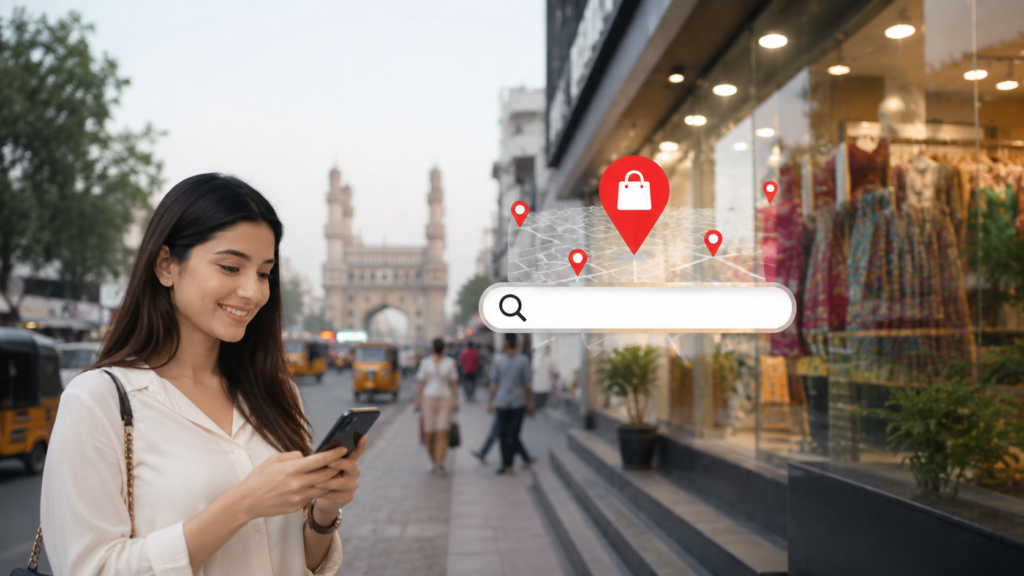
A local business does not need online visibility simply for the sake of being seen. It needs visibility that helps bring the right customers closer to the store. In Hyderabad, people increasingly use search engines to find businesses, compare their options, check locations, and decide where to spend their money. This makes local search an important part of customer acquisition. With the right SEO strategy, businesses can appear when potential customers are actively looking for their products or services. The objective is not simply higher rankings. It is to turn search visibility into enquiries, calls, direction requests, appointments, and physical visits.
The Customer Journey Often Starts Before They Reach Your Store
For many local businesses, the customer journey begins long before someone walks through the door.
A customer may first recognize a need, search online, compare businesses, check information, and decide whether a particular business is worth visiting.
Search engines influence several of these decisions.
This is why Local SEO Hyderabad strategies should focus on more than rankings. The goal is to make a business visible at the point where a potential customer is already showing interest.
The timing of that visibility matters.
Someone searching for a local product or service is often closer to making a decision than someone who happens to see a business on social media. If your business appears at that moment with useful and trustworthy information, the chances of generating an enquiry or visit can increase.
The customer journey can involve several actions:
- Discovering the business through search
- Checking its profile
- Reviewing available information
- Reading customer feedback
- Visiting the website
- Checking the location
- Contacting the business
- Visiting the store
A well-planned local SEO strategy helps connect these actions into a smoother journey.
Search Visibility Is Not the Same as Store Visibility
A business can have a website, social media accounts, advertisements, and plenty of online content without being easy to discover through local search.
This distinction is important.
An online presence means a business exists across digital platforms. Local search visibility means potential customers can find that business when they search for something relevant to their needs and location.
For a physical store, the second one can be far more valuable.
A business might receive website visitors from different parts of the country, but if most of those visitors cannot realistically become customers, the traffic may have limited commercial value.
Local SEO changes the focus from:
“How many people visited my website?”
to:
“How many relevant people in my service area discovered my business and took action?”
That shift helps businesses concentrate on customers who are more likely to generate real enquiries and visits.
Google Has Become Part of the First Impression
For many customers, the first interaction with a business does not happen at the physical location.
It happens on Google.
Before visiting, a potential customer may see the business name, photographs, reviews, opening hours, services, website, and location information.
This digital first impression can influence whether the person continues toward the business or chooses another option.
That is why Google Business Profile optimization should be treated as an important part of a local marketing strategy rather than simply completing a profile once.
The information should accurately represent the business and give customers enough information to make their next decision.
What happens when information does not match?
Even small inconsistencies can create unnecessary friction.
If the website displays one phonenumber while another platform shows something different, customers may hesitate to make contact. If opening hours are outdated, someone may arrive at an inconvenient time. If location information is unclear, a customer may choose a competitor that appears easier to reach.
Accurate information is therefore not only an SEO requirement.
It is part of the customer experience.
Businesses should regularly review important information across their website, Google profile, and other relevant platforms.
Your Location Can Become a Competitive Advantage
Local businesses sometimes treat their physical location as nothing more than an address.
For search visibility, location can be much more valuable than that.
Customers often want convenience. They want to find businesses that are relevant to their area and easy to reach.
A strong local search optimization strategy helps communicate this relevance through the website, Google Business Profile, location pages, and other online signals.
However, effective location targeting is not simply about adding neighborhood names throughout the website.
Build relevance around the areas you actually serve
Businesses should first understand their genuine service area.
This can be based on:
- Existing customer locations
- Physical branches
- Delivery or service areas
- Areas generating enquiries
- Locations with strong demand
- Areas targeted for expansion
This creates a more focused strategy.
Instead of trying to appear everywhere in Hyderabad, a business can concentrate its SEO efforts on locations that have actual commercial value.
Turn a Google Maps Listing Into a Reason to Visit
Google Maps is more than a navigation platform.
For local businesses, it can also be an important discovery and decision-making channel.
A potential customer can find a business, review its information, compare it with other options, and request directions without ever visiting the company’s website.
This makes the quality of the business profile important.
A strong profile should give customers enough information and confidence to take the next step.
Important elements include:
- Accurate business information
- Relevant business categories
- Current photographs
- Updated services
- Correct operating hours
- Genuine customer reviews
- Accurate location details
This is where Google Maps SEO becomes useful. The objective is not simply to appear on Maps, but to improve the business’s relevance and visibility for searches that can lead to customer action.
The more uncertainty a customer has, the more difficult it can be to convert a search into a visit.
A complete and trustworthy profile helps reduce that uncertainty.
Reviews Are More Than a Reputation Metric
Reviews are often treated as a number that businesses want to increase.
Their real value is much broader.
Reviews help potential customers understand what they can expect from a business. They can influence trust, expectations, and the perceived quality of the customer experience.
A strong review strategy should therefore focus on authenticity and consistency.
Businesses should encourage genuine customers to share their experiences rather than relying on artificial methods.
It is also useful to pay attention to what customers repeatedly mention.
Review patterns can reveal:
- What customers value most
- Where the experience is strongest
- Where improvements are needed
- Which services receive attention
- What information customers may want before visiting
This makes customer feedback useful not only for reputation management but also for improving the overall customer experience.
Your Website Has One Job After the Search
Once local search brings someone to your website, the website should help them move forward.
A visitor should not have to spend several minutes looking for basic information.
A local business website should communicate three things clearly:
What do you offer?
Where are you located?
How can I contact or visit you?
These answers should be easy to find, particularly on mobile devices.
A local visitor may want to:
- Call the business
- Send an enquiry
- Start a WhatsApp conversation
- Get directions
- Book a service
- View available services
- Check operating hours
The website should make these actions straightforward.
Design the website around customer decisions
A website should not be organized only around what the business wants to communicate.
It should also reflect what a customer needs to know before making a decision.
Important information should be presented in a logical order so that visitors can understand the business and take action without unnecessary effort.
Clear navigation, fast loading pages, visible contact options, and accessible location information can remove friction from the customer journey.
Content Should Help Customers Decide, Not Just Help You Rank
SEO content can become repetitive when businesses create articles solely around keywords.
A page may contain the target phrase but still fail to provide anything useful to the reader.
Good content should have a purpose.
It should help potential customers understand a service, solve a problem, evaluate their options, or make a more informed decision.
The keyword should support that purpose rather than control the entire article.
Build content around the questions behind the search
A search query often represents a larger concern.
A potential customer may be looking for information about a service, trying to understand what to expect, comparing alternatives, or deciding whether a particular business is suitable.
Content that addresses these concerns can support customers before they make contact.
It can also demonstrate that the business understands its industry and customer requirements.
Avoid forcing keywords into every paragraph
Repeating the same phrase unnecessarily can make content difficult to read and can make the page feel artificial.
Search engines are increasingly capable of understanding topics, context, entities, and search intent.
For this reason, content should prioritize:
- Natural language
- Clear explanations
- Relevant information
- Search intent
- User experience
A page written for people first is more likely to remain useful over time.
Local Authority Is Built Beyond Your Own Website
A business website is only one part of its online identity.
Search engines can encounter information about a business across many other websites and platforms.
Relevant citations, mentions, and backlinks can help strengthen the wider authority of a business.
However, the focus should be on relevance and quality rather than collecting links simply to increase numbers.
Potential opportunities can include:
- Relevant business directories
- Industry platforms
- Local publications
- Professional organizations
- Business communities
- Relevant editorial websites
The purpose is to establish the business as a genuine and relevant entity within its industry and location.
Keep business information consistent
The core business information should remain accurate across important online platforms.
This includes:
- Business name
- Address
- Phone number
Inconsistent information can confuse customers and create conflicting signals across the web.
Regularly reviewing important business listings helps keep the online presence accurate and reliable.
What Happens After Someone Finds You?
This is where many SEO strategies stop too early.
A business may celebrate higher impressions, improved rankings, or increased website traffic without asking what happened afterward.
Did the customer call?
Did they send an enquiry?
Did they request directions?
Did they book?
Did they visit?
These actions are much closer to actual revenue.
Measure the actions that matter
Businesses should monitor metrics that are connected to customer acquisition.
These can include:
- Phone calls
- Website enquiries
- Direction requests
- Appointment bookings
- WhatsApp conversations
- Google Business Profile interactions
- Local organic traffic
- Website conversions
This creates a more practical way to evaluate SEO performance.
A campaign should not be considered successful simply because a keyword moved higher in search results.
The stronger question is whether that visibility contributed to meaningful customer actions.
When Good Rankings Still Do Not Bring Customers
A business can rank well and still struggle to generate physical visits.
This usually means visibility is only one part of the problem.
A customer may find the business but lose interest because information is incomplete, the reviews are weak, the website is difficult to use, or the next step is unclear.
This is why SEO should work together with conversion optimization.
Search visibility brings the customer to the digital doorstep.
The website, business profile, reputation, and customer experience help convince them to take the next step.
This is also why businesses should avoid judging SEO entirely by ranking reports.
A better approach is to look at the complete customer journey and identify where potential customers are being lost.
Common Local SEO Mistakes That Reduce Store Visits
Local SEO can become ineffective when businesses overlook basic but important issues.
Treating SEO as a one-time activity
Search behavior changes, competitors change, business information changes, and customer expectations change.
Local search optimization therefore requires regular monitoring and improvement.
Targeting too many locations
Trying to rank for every area of Hyderabad can dilute the strategy.
Businesses should focus on locations they genuinely serve rather than creating large numbers of low-value pages.
Ignoring online reputation
A business can have good search visibility but still lose customers if its online reputation creates doubt.
Reviews and customer feedback should therefore be treated as an important part of local marketing.
Making customers work to find information
A website that hides contact details, location information, or important services can lose potential customers even when it receives strong search traffic.
The transition from search to enquiry should be as simple as possible.
A Practical Local SEO Roadmap for a Businesses
Local SEO becomes easier to manage when it is treated as a structured process.
Phase 1: Build the foundation
The first stage should focus on making the business information accurate and the website technically sound.
This includes:
- Website audit
- Google Business Profile optimization
- Local keyword research
- NAP consistency
- Technical SEO
- Mobile optimization
- Service page improvements
Phase 2: Increase local visibility
Once the foundation is ready, the focus can shift toward strengthening relevance and authority.
This can involve:
- Location-focused content
- Review management
- Relevant citations
- Quality backlinks
- Website content improvements
- Regular profile maintenance
Phase 3: Monitor customer actions
SEO should continue beyond the initial optimization.
Performance should be reviewed regularly to understand:
- Which searches generate visibility
- Which pages generate enquiries
- Which locations perform well
- Where visitors leave the website
- Which activities generate stronger results
This information can then be used to refine the strategy.
How SEO Can Become a Long-Term Source of Local Customers
The strongest local SEO strategies are not built around one ranking or one campaign.
They are built around consistent visibility and continuous improvement.
When a business maintains accurate information, develops useful content, builds a credible reputation, strengthens local authority, and improves the customer journey, its online presence becomes more useful over time.
This is where professional local SEO services can provide value.
The strategy can be adjusted based on changes in search behavior, competition, customer demand, and business objectives rather than relying on a fixed set of SEO activities.
The ultimate objective is simple: make it easier for relevant customers to discover the business, trust it, contact it, and visit it.
Conclusion
Local SEO gives Hyderabad businesses an opportunity to connect online searches with real customer activity. When a business appears for relevant local searches, provides accurate information, builds trust through genuine reviews, and makes the next step easy, digital visibility can contribute directly to physical store visits. Effective SEO Services in Hyderabad should therefore focus on more than rankings and traffic. The real goal is to attract relevant customers and guide them from search to action. With consistent optimization, useful content, strong local relevance, and ongoing measurement, businesses can build a stronger presence in local search and create a more reliable path from online discovery to offline customers.